Rats Control Services in Hyderabad by Verified Professionals
Rats control in Hyderabad from Rs 799. Rodenticide bait, glue traps, snap traps and entry point treatment, verified professionals, fixed quote before work begins.
Select Rats Control and confirm your service requirements.
Step 2: Verify Your Details
Enter your name, phone number, and preferred service schedule.
Step 3: Get a Verified Professional
We assign a trusted and background-verified professional near you.
Step 4: Pay Securely After Service
Make secure payment after successful service completion.
WHY PROEAZY
Why Choose ProEazy for Rats Control in Hyderabad
Verified professionals, transparent pricing, and reliable
rats control services across Hyderabad.
Verified Professionals
Aadhaar ID verification, skill assessment, and genuine customer ratings ensure trusted service professionals.
On-Time Service
Get timely service updates and dependable professionals who arrive as scheduled.
Secure Payments
Pay safely using UPI, cards, net banking, or wallets with encrypted payment processing.
Quality Assurance
Customer satisfaction comes first with reliable service quality and professional support.
Customer Reviews — Rats Control in Hyderabad
Verified reviews from customers who booked
rats control services in Hyderabad
N
Naveen M
★
★
★
★
★
3BHK in Uppal near the Musi River floodplain with rat activity in the kitchen and utility room. The rats control team placed glue traps and bait stations at all activity points and identified entry gaps near the drainage penetrations. Professional approach and transparent pricing throughout
Top Review
S
Swapna D.
★
★
★
★
★
2BHK in HITEC City with rats entering through the kitchen area during the monsoon. ProEazy sent a professional rats control team that treated all identified entry and activity points thoroughly. Explained the bait station monitoring process clearly. Quote matched billing exactly
R
Ramesh K.
★
★
★
★
★
Rat activity in our kitchen in Secunderabad had been persistent through the pre-monsoon heat period. ProEazy's rats control team identified two entry points near the drainage pipe penetrations from the Musi River drainage network and placed bait stations and traps at all activity points. Confirmed price before they started. Activity stopped within a week
FAQs About Rats Control in Hyderabad
Find answers to common questions about
rats control services in Hyderabad.
How often should rats control be done in Hyderabad?
Pre-monsoon May treatment and post-monsoon October treatment are the two most important annual rats control windows for Hyderabad homes with a history of rat activity. Hyderabad's bimodal rat pressure cycle — the April to June pre-monsoon Deccan Plateau heat driving rats from drainage systems into buildings, and the October post-monsoon flooding driving them from Musi River drainage into residential zones — makes both windows equally important. Ground-floor units near Musi River drainage connections in Secunderabad and Uppal benefit from quarterly rats control bait station maintenance.
What are the signs of rat infestation in a Hyderabad home?
Droppings along skirting boards, behind appliances, and in kitchen cabinet bases are the most consistent sign of rats in a Hyderabad flat. Gnaw marks on food packaging, wooden furniture legs, and electrical cable insulation indicate active rat activity. Scratching sounds in walls or ceilings at night indicate roof rats moving through building structural cavities. In Hyderabad's Nizam-era heritage buildings in Banjara Hills and Secunderabad with original wooden structural elements, roof rat activity in original roof timbers and upper wall cavities is a consistent rats control complaint from residents of ground-floor heritage homes.
Is rodenticide bait safe for children and pets during rats control in Hyderabad?
Rodenticide bait is placed inside enclosed tamper-resistant bait stations that prevent access by children and pets while allowing rats to enter. Bait stations are positioned in locations inaccessible to children and domestic animals, such as behind appliances, inside utility spaces, and along wall-floor junctions behind furniture. The team lead confirms all bait station and trap placement locations before leaving so you know exactly where they are throughout the premises after the rats control service.
How long before I see results after rats control treatment in Hyderabad?
Rat activity typically reduces significantly within 5 to 7 days of bait station and trap placement. Rodenticide bait works over 3 to 5 days as the rat consumes it over multiple feeding visits before the lethal dose accumulates. Glue and snap traps provide more immediate individual capture. The team lead advises on monitoring the bait stations and traps in the days following the rats control treatment and recommends a follow-up visit if activity persists beyond 10 days.
Are the rats control professionals in Hyderabad verified?
Every ProEazy professional completes Aadhaar ID verification, PAN verification, and a 3-stage skill assessment before they are permitted to take rats control bookings in Hyderabad. Rats control involves handling rodenticide bait and traps in your kitchen and living areas. Every person the team sends is verified and trained before they are permitted on any rats control booking in Hyderabad.
How long does rats control treatment take in Hyderabad?
A 1BHK takes approximately 30 to 45 minutes. A 2BHK takes 45 to 60 minutes. A 3BHK takes 60 to 90 minutes. Duration depends on the number of rooms with active rat presence, the number of identified entry points requiring assessment, and the placement of bait stations and traps. In buildings near the Musi River drainage network in Secunderabad and Uppal where multiple drainage pipe penetrations require assessment, the rats control inspection phase takes additional time to address each entry pathway thoroughly.
What treatment method is used for rats control in Hyderabad?
Rats control in Hyderabad uses CIB-approved rodenticide bait stations, glue traps, and snap traps placed at identified rat activity points. Bait stations are placed along rat runways and near entry points. Glue traps are placed in enclosed areas where rats travel regularly. Entry point assessment during the rats control service identifies all accessible gaps through which rats are entering, with specific attention to Musi River drainage pipe penetrations and the heat-driven entry pathways that are the two primary rat entry sources in Hyderabad's older residential zones.
How much does rats control cost in Hyderabad?
Rats control in Hyderabad costs Rs 799 to Rs 899 for a 1BHK, Rs 899 to Rs 1,099 for a 2BHK, and Rs 1,099 to Rs 1,299 for a 3BHK. The final price within the range is confirmed after the team lead assesses the premises, identifies active rat entry points and activity areas, and determines the number and placement of bait stations and traps before the rats control service begins. No additions are made after work starts.
Why Hyderabad's Bimodal Climate Creates Two Distinct Rat Entry Peaks Every Year
Rats control in Hyderabad addresses a rodent pressure cycle that is bimodal in a way that is specific to the Deccan Plateau climate and that produces two distinct annual peaks of rat entry into residential buildings rather than the single monsoon-driven peak that characterises rat control demand in most Indian cities.
The first rats control peak in Hyderabad occurs between April and June, driven by the Deccan Plateau summer heat. The Norway rat, which is the dominant large rat species in Hyderabad's drainage infrastructure, regulates its body temperature through behaviour rather than physiology. When the surface soil temperature above drainage channels and the internal temperature of open drainage infrastructure rises during the April to June heat peak, Norway rats move upward and inward from the warmest parts of their drainage habitat toward cooler, food-available environments. In Hyderabad's context, this means rats from the Musi River drainage network and the city's open drainage channel system move into residential buildings through drainage pipe penetrations and utility gaps at a higher rate than during the cooler months. Rats control bookings in Hyderabad's older residential zones of Secunderabad, Begumpet, and Ameerpet — which are most directly connected to the Musi River drainage network — peak in April and May, before the monsoon arrives, because the heat displacement is at its most intense in this pre-monsoon window.
The second rats control peak in Hyderabad occurs in October following the monsoon. Between June and September, Hyderabad receives concentrated monsoon rainfall that fills and periodically floods the Musi River drainage channels and open stormwater infrastructure across the city. This flooding drives Norway rats upward from their primary drainage habitat into residential buildings in large numbers through the same drainage pipe penetrations and utility gaps that provide the heat-driven entry pathway in the pre-monsoon period. The post-monsoon October peak in rats control demand represents the displaced rat population that has established new habitats within residential buildings during the monsoon flooding period and is now actively foraging within the building's living spaces.
The Musi River drainage network is the infrastructure that links both peaks to Hyderabad's residential buildings. The Musi River flows through the centre of the city and its drainage system connects Hyderabad's historic residential zones — Secunderabad, Begumpet, Malakpet, Uppal, and LB Nagar — to the river through a combination of Nizam-era underground channels and later GHMC-built stormwater infrastructure. Buildings in these zones have utility pipe penetrations and floor drainage connections that physically connect the building's interior to the drainage network below. Rats control in these zones must address these drainage connections at the entry point level as the primary source of rat entry, not only the surface-level activity visible within the flat.
The roof rat, which is the second major rat species in Hyderabad, operates in the upper structural spaces of buildings and is particularly prevalent in Hyderabad's Nizam-era heritage construction in Banjara Hills, Jubilee Hills, and Secunderabad. Original roof timbers, the gap between original wall plaster and the structural brick behind it, and the carved wooden ceiling elements in heritage bungalows provide extensive roof rat harbour and travel routes that are not present in newer concrete construction. Rats control in Nizam-era heritage buildings therefore includes a specific upper structure and roof timber assessment that is additional to the standard drainage entry point assessment required in all Hyderabad buildings.
What the Professional Rats Control Service in Hyderabad Covers
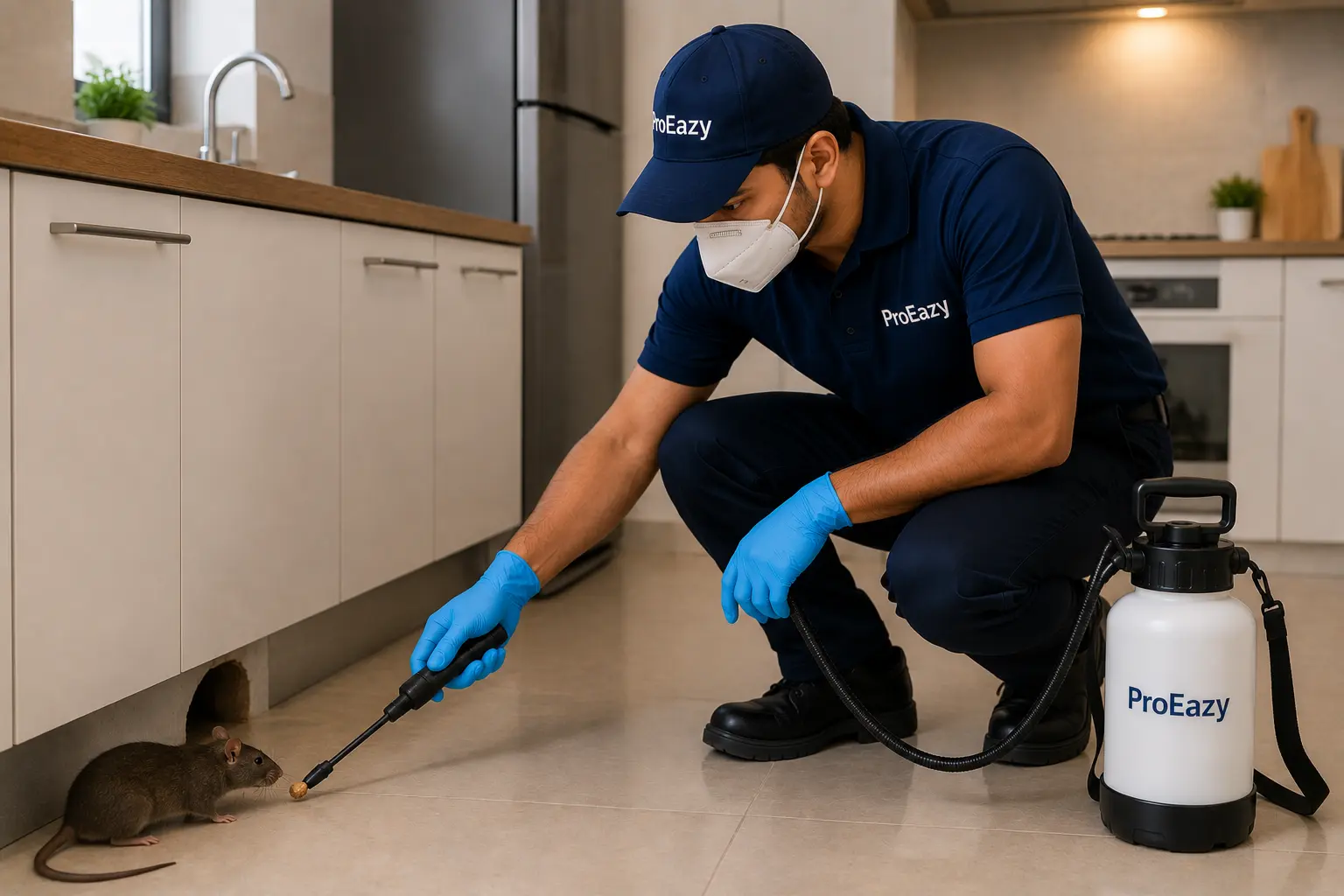
Pre-Treatment Inspection: The team lead inspects every room before the rats control treatment begins, identifying active rat runways along skirting boards and wall-floor junctions, gnaw marks on food packaging and cable insulation, droppings at activity points, and entry gaps in utility pipe penetrations, drainage connections, door gaps, and any other accessible openings. In Musi River drainage-connected buildings in Secunderabad, Uppal, and Malakpet, the drainage pipe penetrations in kitchen and bathroom floor slabs are assessed as primary Norway rat entry points from the drainage network below. In Nizam-era heritage buildings in Banjara Hills and Secunderabad, the original roof timber spaces and upper wall cavities are assessed as roof rat harbourage areas. The inspection maps the rat movement pattern and confirms the species present before the rats control treatment plan is finalised.
Rodenticide Bait Station Placement: CIB-approved rodenticide bait is placed inside enclosed tamper-resistant bait stations at all identified rat runways and near confirmed entry points throughout the premises. In Musi River drainage-connected buildings, additional bait stations are placed near the drainage pipe penetration areas in the kitchen and bathroom as the primary Norway rat entry zones from the drainage network. Rodenticide bait works over 3 to 5 days of cumulative feeding before the lethal dose is reached, ensuring the rat returns to its harbourage before dying and preventing the dead-in-wall odour issue associated with over-dosed bait.
Glue Trap Placement: Glue traps are placed in enclosed spaces along confirmed rat runways where their flat profile allows deployment in locations bait stations cannot access. In Nizam-era heritage buildings, glue traps are specifically placed along the original wall base gap and the upper wall cavity access points where roof rat runway activity concentrates during the rats control treatment. All placement locations are confirmed with the resident before deployment.
Snap Trap Placement: Snap traps are placed at high-activity entry and runway points for larger Norway rat individuals where immediate capture is the priority. All placement locations are confirmed with the resident before traps are set during the rats control service. Traps are positioned along wall-floor junctions with the trigger mechanism facing the wall, which is the direction from which rats approach along their established runway.
Entry Point Assessment: Every accessible gap, penetration, and opening identified during the inspection is assessed for its contribution to rat entry. Musi River drainage pipe penetrations in kitchen and bathroom floor slabs receive specific sealing material recommendations as the primary bimodal-pressure Norway rat entry source in older Hyderabad zones. Nizam-era building upper wall gaps and roof timber access points receive assessment for roof rat entry. Physical sealing recommendations are given for each identified entry point with the appropriate material specified. Sealing the confirmed drainage entry gaps is the single most effective long-term rats control measure for Hyderabad's Musi River-connected buildings.
Post-Treatment Briefing: The team lead confirms all bait station and trap locations before leaving, advises on monitoring placements in the days following the rats control treatment, gives specific guidance on dead rat handling, explains the expected activity timeline of 5 to 7 days for full effect, and recommends the pre-monsoon May and post-monsoon October follow-up rats control schedule for Hyderabad's bimodal pressure cycle.
Rats Control Charges in Hyderabad — Upfront Rate, No Hidden Costs
Home size and number of rooms with active rat presence, which is the primary pricing variable for rats control in Hyderabad. Number of active entry points identified during the inspection, as Musi River drainage-connected buildings in Secunderabad, Uppal, and Malakpet typically have more drainage pipe penetration gaps requiring assessment than buildings in the newer IT corridor zones. Severity of infestation and the extent of active rat runways across the flat. Whether the rats control visit falls during the bimodal pre-monsoon heat peak or the post-monsoon flooding peak, as both periods involve heavier Norway rat entry loads from the Musi River drainage system than the inter-peak months. Building type, as Nizam-era heritage buildings require additional upper structure and roof timber rat assessment beyond the standard drainage entry point scope.
Market context for Hyderabad. Professional rats control in Hyderabad starts from around Rs 799 for a 1BHK. The complete rats control service covering inspection with bimodal Hyderabad pressure assessment, rodenticide bait station placement, glue trap placement, snap trap placement, comprehensive entry point assessment with Musi River drainage-specific sealing recommendations, and post-treatment briefing in one visit using CIB-approved materials is the professional standard. ProEazy's Rs 799 to Rs 1,299 covers this full rats control treatment in one confirmed price with no additions on the day.
How the Rats Control Service in Hyderabad Works — Step by Step
Step 1. Booking and price confirmation. Enter your Hyderabad locality, home size, and preferred date and time at proeazy.in. Your confirmed price range for the rats control service is displayed before payment. Booking takes under 2 minutes.
Step 2. Pre-treatment inspection. Team lead inspects every room for rat droppings, gnaw marks, grease trails, runway activity, and entry points. Musi River drainage pipe penetrations assessed in older zone buildings. Nizam-era building upper wall cavities and roof timber access points assessed where applicable. Bimodal pressure context — heat-driven versus monsoon-driven — confirmed. Species identified and rats control treatment placement plan confirmed before any bait or trap is deployed.
Step 3. Preparation check. Loose food items stored in sealed containers. Kitchen appliances pulled away from walls. Children and pets confirmed away from treatment areas. Preparation confirmed before the rats control treatment begins.
Step 4. Rodenticide bait station placement. CIB-approved rodenticide bait placed in enclosed tamper-resistant bait stations at all confirmed runway and entry point locations. Additional stations placed near Musi River drainage pipe penetration areas in eastern zone buildings as the primary Norway rat entry source.
Step 5. Glue trap placement. Glue traps deployed along confirmed rat runways in enclosed spaces. In Nizam-era heritage buildings, specific placement along original wall base gaps and upper wall cavity access points where roof rat activity concentrates. All placement locations confirmed with resident before deployment.
Step 6. Snap trap placement. Snap traps set at high-activity entry and runway points for larger Norway rat individuals. Trigger mechanism positioned facing the wall along the established runway. All rats control trap locations confirmed with resident before deployment.
Step 7. Entry point assessment. Musi River drainage pipe penetrations in kitchen and bathroom floor slabs given specific sealing material recommendations for older zone buildings. Nizam-era upper wall gaps assessed for roof rat entry. All other identified gaps given sealing recommendations with appropriate material type specified.
Step 8. Post-treatment briefing. All bait station and trap locations confirmed with resident. Monitoring instructions given. Dead rat handling guidance provided. Expected activity timeline of 5 to 7 days explained. Pre-monsoon May and post-monsoon October follow-up rats control schedule recommended for Hyderabad's bimodal pressure cycle.
Step 9. Secure payment. Pay via UPI, card, netbanking, or wallet at the confirmed price. No cash required.
Why Hyderabad Residents Choose ProEazy for Rats Control
Verified professionals handling rodenticide in your home
Every ProEazy professional completes Aadhaar ID verification, PAN verification, and a 3-stage skill assessment before taking rats control bookings in Hyderabad. Rodenticide bait placement in kitchen and living areas requires people who are verified and trained before they are permitted on any rats control booking.
Musi River drainage entry assessment included as standard
The Musi River drainage pipe penetrations in kitchen and bathroom floor slabs are the primary Norway rat entry pathway in Hyderabad's Musi River-connected residential zones in Secunderabad, Uppal, Malakpet, and Begumpet. Assessment and sealing recommendations for these drainage entry points are included as standard in every ProEazy rats control visit in these zones. This drainage assessment is what separates a rats control treatment that holds from one that requires monthly repetition because the bimodal heat and flood entry sources have not been identified and addressed.
Tamper-resistant bait stations throughout
Rodenticide bait is placed inside enclosed tamper-resistant stations on every ProEazy rats control booking in Hyderabad. Bait is never placed loose. This is the standard that protects children and pets while maintaining full effectiveness against rats.
Bimodal Hyderabad rats control calendar
The pre-monsoon May and post-monsoon October rats control windows address Hyderabad's specific bimodal pressure cycle from the Musi River drainage heat displacement peak and the monsoon flooding displacement peak respectively. The team lead confirms the recommended follow-up timing for your specific zone at the end of every rats control visit.
The quote is the bill
The confirmed price after the pre-treatment inspection is the price you pay. No additions after the rats control treatment begins.
One rate across every ProEazy page
Rs 799 to Rs 1,299 on this page matches the Rats Control rows on the main Hyderabad pest control page exactly.
On-time service guarantee
The slot you book is the slot the rats control team arrives in. For treatment scheduled before or immediately after Hyderabad's bimodal pressure peaks, timing relative to the drainage displacement cycle matters and this guarantee is the one that counts.
Book in under 2 minutes
Home size, locality, date, time, confirmed price, booking done.
Rats Control Services Across Hyderabad's Key Zones
Secunderabad and Begumpet: The highest rats control demand zone in Hyderabad driven by Musi River drainage network connectivity. Both the pre-monsoon heat peak in April to June and the post-monsoon flooding peak in October drive Norway rat entry from the drainage system into residential buildings in these zones at a higher volume than anywhere else in the city. Ground-floor and first-floor units in buildings with original Nizam-era drainage connections in Secunderabad report the most persistent rats control challenges. Quarterly bait station maintenance is the recommended rats control frequency for ground-floor units nearest the Musi River drainage channels in this zone.
Uppal, LB Nagar, and Dilsukhnagar: The eastern Musi River floodplain zones where rats control demand peaks sharply at both the pre-monsoon May and post-monsoon October windows. The flat floodplain terrain means the Musi River drainage flooding effect is more pronounced here than in Hyderabad's elevated central zones, and rat displacement from the drainage system into residential buildings during the monsoon is more extensive in Uppal and LB Nagar than in Begumpet or Secunderabad. Rats control bookings in this zone have the strongest bimodal pattern of any Hyderabad residential zone.
HITEC City, Gachibowli, Kondapur, and Madhapur: The IT corridor zone where rats control demand follows the post-monsoon October pattern more strongly than the pre-monsoon heat pattern, because the newer construction in this corridor has better structural sealing that reduces the heat-driven entry pathway. Norway rat entry from the Outer Ring Road stormwater drainage during the October flooding is the primary rats control driver in this zone. Ground-floor units in HITEC City buildings near the ORR service road drainage channels report the highest rats control demand in the corridor.
Banjara Hills and Jubilee Hills: The premium residential zones where rats control in Nizam-era heritage bungalows includes specific roof rat upper structure assessment that is not required in apartment-dominant zones. Roof rat activity in original teak roof timbers and upper wall cavities is a consistent rats control complaint from ground-floor heritage home residents. The combination of drainage system Norway rat pressure and heritage structure roof rat harbourage makes rats control in this zone the most comprehensive inspection scope in Hyderabad.
Kukatpally, Miyapur, and Bachupally: The north-western expansion corridor where rats control demand follows the post-monsoon October pattern driven by Hyderabad Metro Phase 2 and township construction drainage displacement. Active construction in this corridor disturbs established ground-level rat habitats and drives displaced populations into existing residential buildings during the monsoon. Pre-monsoon May rats control treatment and active entry point sealing are particularly important for buildings in active construction-adjacent sectors of this corridor.
Availability for your specific locality and date can be confirmed at proeazy.in before booking.
Book a Professional Rats Control Service in Hyderabad Today
Rs 799 to Rs 899 for a 1BHK. Rs 899 to Rs 1,099 for a 2BHK. Rs 1,099 to Rs 1,299 for a 3BHK. Full premises inspection with bimodal Hyderabad pressure assessment covering Musi River drainage entry points in older zones and Nizam-era upper structure assessment in heritage buildings, CIB-approved rodenticide bait in tamper-resistant stations, glue trap and snap trap placement at all activity points, comprehensive entry point assessment with drainage-specific sealing recommendations, and post-treatment briefing with bimodal seasonal follow-up schedule in one confirmed rats control visit. Aadhaar and PAN verified professionals. Fixed quote before work begins, and the same rates published on our main Hyderabad pest control page, because a professional rats control service should not carry two prices.
Book your rats control in Hyderabad in under 2 minutes at proeazy.in or call us at +91-8368401257. Pre-monsoon May and post-monsoon October are the two most important annual rats control treatment windows for Hyderabad buildings with a history of rat activity from the Musi River drainage network. Book 5 to 7 days ahead for those periods. For buildings with persistent multi-unit rat pressure from the Musi River drainage infrastructure, speak to the rats control team directly before booking online.

 Ants Control