Which pests surge during Delhi's monsoon, what you can do yourself, and when to call a verified professional — with real pricing from ₹799
Summarize this blog post with: ChatGPT | Perplexity | Grok
Every Delhi homeowner knows the first week of monsoon brings relief from the heat and, within days, the cockroaches. What most people don't realise is that the same rains also silently activate termite colonies in wooden fixtures, push rodents indoors through drainage pipes, and create mosquito breeding grounds in places you would never think to check. This guide covers exactly which pests surge during Delhi's monsoon, what you can do yourself before they take hold, and when it is time to call a verified professional with real pricing so there are no surprises.
Monsoon pest control refers to targeted pest prevention and treatment carried out during or before the July–September rainy season, when rising humidity, stagnant water, and waterlogged soil create conditions that significantly accelerate pest breeding and indoor migration in Delhi NCR homes. It is distinct from year-round pest management because the triggers are seasonal and predictable, which means the response can be timed rather than reactive.
To put it simply, monsoon pest control is about getting ahead of a surge you already know is coming. During the dry months, most Delhi homes deal with the occasional cockroach or ant trail. Once the rains arrive, those same pests multiply quickly, and new ones termites and rodents in particular become far more active.
Delhi NCR is one of the most affected regions in India for monsoon pests. The reason is a combination of high humidity, dense apartment living, ageing drainage in older colonies, and large stretches of low-lying ground that hold water after heavy rain. For homeowners in Delhi, Noida, Gurgaon, Faridabad, and Ghaziabad, the monsoon is the single most important pest window of the year.
Monsoon rains trigger pest surges in Delhi homes because stagnant water creates mosquito breeding grounds, saturated soil loosens termite colonies from their underground nests, and indoor humidity levels create ideal conditions for cockroach reproduction all within the same two to three week window after the rains begin. The mechanisms are physical and consistent, which is exactly why the surge repeats every year.
First, consider standing water. After a heavy Delhi downpour, water collects in cooler trays, blocked balcony drains, plant saucers, and low-lying colony streets. For example, waterlogged pockets in parts of Dwarka, East Delhi, and low-lying Noida sectors can hold water for days, and mosquitoes need only a small amount of still water to breed.
Second, the soil itself changes. When the ground becomes saturated, termite colonies that normally sit deep underground are pushed toward the surface and into the foundations, skirting boards, and wooden fixtures of nearby homes. This is why older constructions near green belts or the Yamuna floodplain often see termite activity spike specifically during and just after the rains.
Third, indoor humidity rises sharply. Cockroaches reproduce faster in warm, humid conditions, and Delhi's monsoon humidity turns kitchens, bathrooms, and drain lines into ideal breeding zones. At the same time, rodents seeking dry shelter move indoors through drainage pipes and gaps around utility lines. As such, a single home can face several different pest pressures at once during peak monsoon.
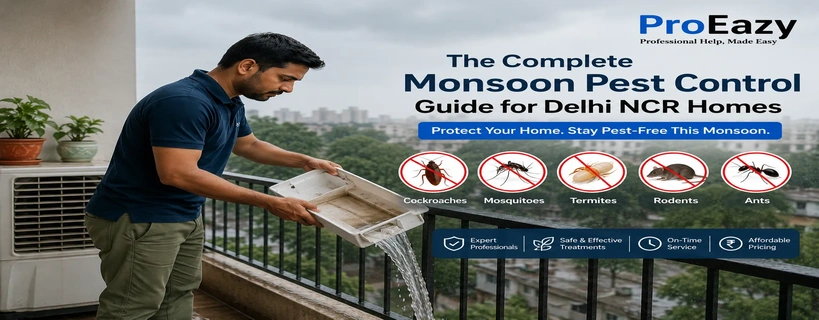
Five pests are most active in Delhi NCR homes during the monsoon: cockroaches, mosquitoes, termites, rodents, and ants. Each is triggered by a specific monsoon condition, and each shows up in a predictable part of the home. Knowing where to look is the first step to controlling them.
Let's take a look at each one.
Cockroaches are the most common monsoon pest in Delhi homes, and they concentrate around kitchen drains, under sinks, and behind appliances where humidity and food moisture collect. The monsoon humidity accelerates their breeding cycle, so a minor problem in June can become a visible one by late July.
For example, if you start seeing cockroaches in the evening near the kitchen sink or behind the refrigerator, that is early-stage activity. The early warning sign to watch for is a musty smell near drain openings, which often appears before the cockroaches themselves become visible.
Mosquitoes breed in stagnant water, and during Delhi's monsoon, the most common breeding sites inside homes are air-cooler trays, plant saucers, overhead tank overflows, and blocked balcony drains. Because mosquitoes need very little water to breed, even a forgotten bucket on a balcony can become a source.
This matters beyond the nuisance of bites. Because mosquito-borne illnesses such as dengue and malaria are transmitted by mosquitoes that breed in stagnant water, the weeks during and immediately after the monsoon are when the risk of these illnesses typically rises across Delhi NCR. Eliminating standing water inside and around your home is the most effective way to reduce that risk at the source.
Termites become significantly more active during the monsoon because saturated soil pushes colonies toward the surface and into the wooden fixtures, door frames, and skirting of nearby homes. They are the most damaging monsoon pests because the harm is structural and often hidden until it is advanced.
The early signs of a termite problem during monsoon include thin mud tubes running along walls or skirting boards, wood that sounds hollow when tapped, and small piles of what looks like fine sawdust near wooden furniture. For example, window frames and built-in wardrobes in older Delhi construction are common first targets because the wood sits close to damp masonry.
Rodents move indoors during the monsoon in search of dry shelter, typically entering through drainage pipes, gaps around utility lines, and open vents. Once inside, they head for storerooms, the space behind kitchen cabinets, and any warm, dry corner.
The clearest early warning sign is droppings near food storage areas, along with gnaw marks on packaging or cabling. Plus, a faint scratching sound in walls or false ceilings at night is a common indicator that rodents have already moved in.
Ants become more visible during the monsoon because wet soil disturbs their outdoor nests and drives them indoors toward food and dry ground. Sugar ants in particular form long trails across kitchen counters and near stored food.
For example, a sudden ant trail appearing along a skirting board or window ledge after heavy rain usually means a nest outside has flooded. While ants are the least harmful of the five, large or recurring trails can indicate a bigger nest nearby that DIY methods will not fully resolve.
Here is a quick reference table for all five monsoon pests:
| Pest | Main Monsoon Trigger | Where It Hides in a Delhi Home | Early Warning Sign |
| Cockroaches | Indoor humidity, food moisture | Kitchen drains, under sinks, behind appliances | Musty smell near drains, evening sightings |
| Mosquitoes | Stagnant water | Cooler trays, plant saucers, and balcony drains | Increased bites indoors, larvae in still water |
| Termites | Saturated soil | Wooden frames, skirting, wardrobes | Mud tubes, hollow-sounding wood, fine sawdust |
| Rodents | Seeking dry shelter | Storerooms, behind cabinets, false ceilings | Droppings near food, gnaw marks, night scratching |
| Ants | Flooded outdoor nests | Counters, skirting, near stored food | Sudden trails after heavy rain |
Delhi homeowners can prevent most monsoon pest activity by clearing stagnant water, sealing entry points, managing drainage, and storing food correctly before the rains reach their peak. These steps are most effective when done early, ideally in the first week or two of the season, before pest populations build.
Here is a practical pre-monsoon and during-monsoon checklist:
By doing these steps early, you can reduce monsoon pest activity significantly and, in many mild cases, avoid needing professional treatment at all. That being said, prevention has limits, and knowing when those limits have been reached is important.
You should call a professional for monsoon pest control when you see daytime cockroach activity, visible termite mud tubes, rodent droppings near food storage, or when DIY treatment has not worked within two weeks. These are the signals that a pest population has grown beyond what surface-level home remedies can handle.
To be specific, watch for these situations:
In short, DIY handles prevention and minor activity. Professionals handle established populations, structural pests, and anything that keeps coming back.
A professional monsoon pest control treatment in Delhi typically involves a site inspection, application of CIB-registered chemicals targeted by pest type, sealing of identified entry points, and a follow-up check to confirm treatment effectiveness — the full visit for a standard 2BHK home takes between 1 and 2 hours. The value of a professional visit is that it addresses the source, not just the pests you can see.
Here is how a typical treatment works, step by step.
First, the professional inspects the home to identify which pests are present, where they are breeding, and how they are entering. This inspection stage is what separates targeted treatment from generic spraying.
Second, they apply the right treatment for each pest. This is where the choice of chemicals matters. DIY pest sprays available in Indian retail stores treat surface-level pest activity but do not address breeding sources, colony nests, or structural entry points — professional pest control using IPM protocols and CIB-approved chemicals provides targeted treatment that addresses the root cause rather than visible symptoms. ProEazy's professionals use CIB-registered chemicals and follow Integrated Pest Management (IPM) protocols, which prioritise targeted, lower-toxicity treatment over blanket spraying.
Third, they seal identified entry points and advise you on what to maintain afterwards. Finally, a follow-up check confirms the treatment has worked, which is particularly important for termites and rodents, where a single treatment is not always enough.
Every ProEazy professional who carries out this work is one of ProEazy's verified home service professionals, meaning they complete Aadhaar and PAN verification plus a skill assessment before they are allowed to take any booking. You can book pest control services in Delhi directly and see the professional's verified profile before they arrive.
Pest control charges in Delhi NCR start from ₹749 for a general treatment covering cockroaches, ants, and common household pests, with termite treatment and rodent control priced separately based on the area and severity of the infestation. Transparent, upfront pricing means you see the full cost before you confirm, with no doorstep add-ons.
The important thing to understand is that pest control pricing depends on three factors: the type of pest, the size of your home, and the severity of the problem. A general cockroach-and-ant treatment for a compact flat sits at the lower end. Termite and rodent treatments, which require specialised chemicals and often a follow-up visit, are priced higher.
Here is an indicative pricing guide:
| Service | Starting Price | Notes |
| General pest control (cockroaches, ants) | ₹799 | Standard treatment, most common booking |
| Termite treatment | ₹799
| Priced by area and severity; may need follow-up |
| Rodent/rat control | ₹499 to Rs 850 | Priced by home size and access points |
| Ants control | ₹700 to Rs 1,200 | Often combined with general treatment |
| Commercial / office pest control | ₹2,999 per visit | Priced by area (sq ft) |
Note to editor: confirm the termite, rodent, mosquito, and commercial starting prices against the live service pages before publishing. Only the ₹799 general rate is validated.
For readers who want a full nationwide breakdown of what pest control costs, ProEazy has a detailed guide on how much does pest control cost in India and how often should you do pest control.
Pest control charges are broadly similar across Delhi NCR, though they can vary slightly by city based on local operating conditions and the specific service required. The general starting rate is consistent, while specialised treatments may differ marginally.
For residents outside central Delhi, ProEazy operates across the NCR. You can book pest control in Noida or pest control in Gurgaon at comparable rates, with the same verification standards and transparent pricing applied in every city.
Professional pest control is safe for children and pets when carried out by trained professionals using CIB-approved chemicals at correct dilutions, provided you follow the simple after-care instructions given at the end of the treatment. The safety comes from correct application, which is another reason professional treatment is preferable to untrained spraying.
In practice, this usually means keeping children and pets out of treated areas for a few hours until surfaces dry, and ventilating rooms afterwards. Because ProEazy professionals follow IPM protocols, treatment prioritises targeted, lower-toxicity application over blanket spraying, which is better for households with young children, elderly members, or pets.
Most Delhi homes benefit from one professional pest control treatment at the start of the monsoon, with a follow-up only if activity persists or for structural pests like termites. The exact frequency depends on your home's history and surroundings.
For example, a ground-floor flat near a green belt or a home with a past termite problem may need closer monitoring than an upper-floor apartment. As a general rule, a single well-timed treatment in early monsoon handles most households, while homes with recurring issues may opt for a maintenance schedule.
You do not need to spend money to take the first steps against monsoon pests — several free and low-cost measures make a real difference before any professional treatment. Combining these with a professional visit gives the best results.
For everyday monitoring and prevention, these simple tools help:
When these measures are not enough, professional treatment is the natural next step — and after a heavy monsoon, many Delhi homes also book deep cleaning services in Delhi to clear the damp, dust, and residue the season leaves behind.
The best time to act on monsoon pest control is early — before populations build and before structural pests like termites take hold. Timing is the single biggest factor in how much effort and cost the season will demand from you.
Start with the prevention checklist in this guide. Clear standing water, seal entry points, and store food correctly this week. Then, if you spot any of the professional-treatment signals — daytime cockroaches, termite tubes, rodent droppings, or pests returning within two weeks — book a verified professional rather than waiting for the problem to grow.
To book, visit home services in Delhi or home services in Noida, select pest control, and choose a slot. The booking takes under two minutes, and every professional is Aadhaar and PAN verified before their first assignment.
Monsoon pest control in Delhi NCR is not about panic, it is about timing and the right professional. The pests that surge each rainy season are predictable, which means they are also manageable when you act early and know what to look for.
Start with prevention, watch for the warning signs, and bring in a verified professional the moment DIY stops working. With transparent pricing from ₹799 and a two-minute booking, protecting your home this monsoon is simpler than the season makes it feel. Get your home monsoon-ready today, and let the rains bring only relief not an infestation.
Written by ProEazy Editorial Team — home services content specialists covering cleaning, pest control, and home maintenance for Indian households.
Book verified professionals for cleaning, pest control, catering & more — in under 2 minutes.
Book Now →